Showing posts with label plant molecular biology. Show all posts

Tuesday, February 4, 2025

In memory of our friend David Johnson


David Alfred Johnson Ph.D

2 September 1931 -  4 February 2025


All of us of project GRFT lost a very good friend today


David was one of the project GRFT team from the start.  He specialized in hardware engineering and development. He took charge of particle bombardment technology being used by project GRFT.  He had an interest in this and stated that he thought there were many applications which this technology would be used for in the future and this was only the beginning.  He was inspired by the DIY gene gun that had been built at BioCurious by Jay Hanson.  Based on this design, he built two DIY gene guns for project GRFT. He designed 3D printed nozzles that were optimized for particle spread.  David made many tests with the Gene guns to get the gas pressure adjusted for best cell penetration.  He learned the basics of plant molecular biology in an amazingly short time and helped to get the contamination issues that we were having under control.  

Project GRFT is where it is today, with the micropropagation pipeline in place and gene gun working for transformations, largely because of the knowledge, experience and skills he brought to us.   I personally enjoyed every minute in the lab with David, and I am sure that all of us who had the pleasure of knowing him can say the same.  He was at most of our meetings over the years.  Sometimes he would have trouble with the audio settings on his device, but he would get that working and then have insights to share with us.  

David was thoughtful with the analytical skill set of a great scientist.  He worked very hard and got a lot accomplished. I was always hugely impressed by his abilities to work with a number of different technologies, and to see clearly how they all interact.  Besides being a top scientist and inventor, David had may interests and abilities, for example as an artist and a poet.  David had heart problems.  He said he wasn't in much pain but that he got tired easily.  Little over a week ago during one on the walks that he took for fresh air and exercise, his heart gave out and he collapsed which caused multiple severe injuries.  He was taken to Highland Hospital.  I went to visit him, and he was having trouble breathing. He couldn't swallow or talk.  His wife Leticia was staying with him at the hospital and caring for him tenderly.  I came back the next day, the doctors had changed his meds.  He was breathing without a struggle and looked peaceful.  


Ph.D. Physics (1972)

University of Hawaii. Honolulu, HI.

Dr. Johnson worked as a physist at UC Berkeley Lawrence Lab and the Stanford Linear Accelerator Center.

He did much pioneering work with high energy physics.

Dr. Johnson was the founder, director, and president of TiNi Alloy Company where he managed a research team engaged in development of products using shape-memory alloys.

He owns multiple patents and has published papers.

One of his inventions has travelled to the planet Mars

                               David Johnson and Hector Vera

Wednesday, November 1, 2023

Project GRFT's 2nd Gene Gun

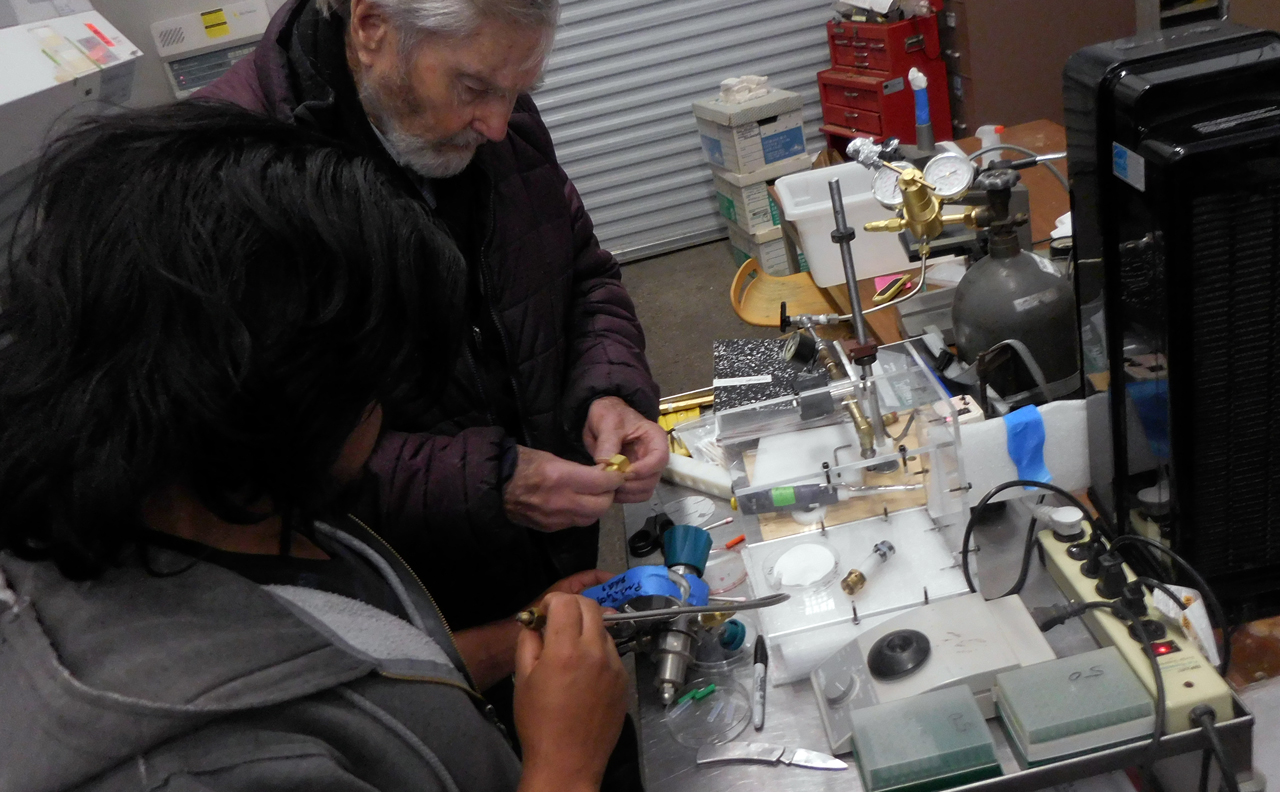
 David checks the 2nd gene gun that he built for leaks prior to it's departure from CCL to Hector's lab.  If there is any leakage in the tubing or valves, helium, being of low density, will escape.  It is this low density of He, combined with its properties of  being non-reactive, non-toxic, inert and diffusible that make it a good choice as a propellent.  


The first gene gun made used gunpowder as a propellent.  This was crude and dirty compared to today's helium powered gene guns.   Good work, David and Hector.


Wednesday, August 30, 2023

gene gun


When the button is pushed as shown in this photo, a measured burst of helium gas propels microparticles carrying DNA plasmid into the plant cells. The plant cells that take up the DNA are transformed to express a protein.  This method of getting DNA into plant cells is called particle bombardment.  This is one of project GRFT's two gene guns built by physicist David Johnson, PhD.

Tuesday, June 27, 2023

Project GRFT: How we spend the summer - happiness is a warm gun


Our team of volunteers is shooting rice embryos with the gene gun on Saturdays at Counter Culture Labs. 


Sreenivas and Nathaniel from Johns Hopkins University have joined us for the Summer.  They provided the first version of the plasmid containing the griffithsin construct which we have been cloning on Fridays.  The work on Saturday is to get a layer of plasmid to adhere by forming an adsorption ionic bond with 0.7 micron Au microparticles.  This procedure has an element of timing, including vortexing and centrifuging, while keeping everything cool.  Here Anthony prepares a centrifuge.  The rotor is chilled in a freezer before centrifuging.


  First the Au microparticles are washed multiple times with cold ethanol.  The last wash is done with a pH 9.0 borate buffer. 


Nathaniel has the pipettes ready with tips and lined up, he will quickly add plasmid, CaCl2, and protamine and vortexed immediately.  


This kept cold while allowing to rest for 10 minutes.  During this time precipitation occurs. 

After centrifuging the supernatant is removed and the precipitate is re-suspended in pure ethanol.

Then the particles are carefully pipetted into the cartridges which will be loaded into the gene gun.  Here David instructs Sreenivas on the cartridge loading. 


The ethanol needs time to evaporate and then the cartridges can be loaded into the gene gun.

Here’s a closer look at the cartridges after loading.


Rice embryos are placed between 2 wire screens in the nozzle of the gene gun.

Sreenivas opens the valve to allow the helium gas to fill the measuring tube of the gene gun before firing.


David furiously takes notes on all of this.


Monday, January 30, 2023

Red Cross warning to an unprepared world.

 https://www.aljazeera.com/news/2023/1/30/world-dangerously-unprepared-for-next-pandemic-ifrc


A refresher for those who have been reading these posts or an introduction to those who are new here follows:

GRFT, or Griffithsin is an antiviral lectin. It has shown to inhibit infection by a number of viruses while being itself nontoxic. Project GRFT has a goal of producing GRFT by expression of the gene (derived from a red seaweed) in Oryza (rice).  As rice is a widely grown food crop in many countries of the world, this method has the potential to empower farming communities with limited resources a means to combat viral outbreaks that will undoubtedly occur in the future. We feel that our efforts support global public health, a basic human right.

It should be noted that both Griffithsin and rice are considered nontoxic and safe.

Project GRFT is a group of friends who are volunteering to develop technology to do large scale global biomanufacturing of GRFT through plant molecular biology. 

Project GRFT does not have as its intent to produce pharmaceuticals but rather to provide the raw material for biomanufacturing which we may perhaps call "GRICE"  

As a project of Counter Culture Labs we have non-profit status and we always welcome your donations, both of money and in-kind donations such as supplies (petri dishes, reagents, etc.).  

We are now working in three fully functional laboratories. 

One is located at Counter Culture Labs in Oakland, California

Another is located in Baltimore Maryland at Johns Hopkins University

The newest lab is located near Modesto, California 

This is our effort to respond to the challenge described in the Red Cross warning.  


Saturday, October 29, 2022

Rice plate


Kat, Patrick and Grier check the plates in the incubator
Every organism has a food they like.  We feed the rice calluses by plating the embryos on Callus Induction Media (CIM) 
They are masses of cells and with care will eventually grow into rice plants 
As they grow we break them apart.
We re-plate the pieces and the pieces grow. 
Callus growth is slow and we are working on monitoring how much growth takes place over time.  
Every organism thrives in a certain temperature range.
The incubator is set at 25C for the calluses.
The calluses on CIM are kept in the dark.  
At later stages different media is used and light is introduced so that photosynthesis can occur and then roots and shoots form.


Wednesday, July 27, 2022

DNA plasmid under construction

Project GRFT update.  Sreenivas Eadara and the Project GRFT DNA crew in Baltimore are making good progress with the plasmid construct assembly.  

Beautiful bands:


Saturday, July 16, 2022

2022 project GRFT ongoing labwork Updates


After a rather disastrous Winter with flooding and other problems at CCL, and the closure of one of our other Bay Area labs due to financial limitations, we are recovering. Spring has been a time of growth and progress for project GRFT.  Micropropagation of rice by Hector Vera on agar has got the early problems with contamination under control and cloning is progressing nicely using a progression of media.  We now have plates with happily growing rice calluses that we are continually preparing for transformation by particle bombardment.  Hector is finishing up a lab complete with a gene gun.  UCB students Allison Nakagawara and Maya Douglas joined the project and have been working on preparation of media and buffers, monitoring callus growth and cloning the calluses.  David Alfred Johnson, PhD and David Finn have teamed up to work on the nozzle end of the gene gun. 3d printed parts had ragged edges and were not able to withstand the temperatures in the autoclave.  David Johnson has built two gene guns.  David Finn has located a high-temperature printer to print the parts with clean edges and able to withstand the heat of autoclaving.  In earlier experiments the blast from the gun blew the target plant material completely off the plate.  The solution being tried now is to place the target between to disks of stainless steel fine mesh inserted into the nozzle.  Sreenivas Eadara and the team at Johns Hopkins are working on assembly of the plasmid construct under the guidance of Noam Prywes, PhD (who is doing a research project at UCB to explore rubisco biochemistry and chloroplast transformation technology in plants). 

Photo taken on the 15th of July 2022 at Counter Culture Labs in Oakland, CA.


From left to right: Allison Nakagawara, Maya Douglas, David Finn, Eddy Spinner, David Johnson, and Hector Vera.


Tuesday, September 21, 2021

Hector's work on project GRFT

Introducing Mr. Hector Vera who is one of our talented, dedicated and hard working volunteers at project GRFT.  Hector speaks from outside a laboratory in Oakland, California where our gene guns are now being built and tested.  


Thursday, April 22, 2021

Project GRFT in the lab and in the fields - a plan


People have asked the question, “If Griffithsin is such a potent anti-viral, why is it not being manufactured?  Why is it not generally available and being used to stop viral outbreaks such as Covid-19?”  It’s a very good question.  There are a few efforts being made to biomanufacture griffithsin and at least one to get it into clinical trials.  In March, 2020, I couldn’t find anything to indicate that it was in any pharma company pipeline. I decided that if no one is working on this, I would put my shoulder to the wheel and do work on its development.  First I reached out to researchers around the world who had worked with griffithsin.  I reached out to my friends in the biohacking community.  There were a few people who responded at first and we started a group of friends to take on a rather enormous project with a goal of making griffithsin available to the world. 

The arts of molecular biology and biotechnology demonstrate that genes from one organism may be placed into another organism which will read the sequence information and from it make a peptide or polypeptide in the cells.  There is a large and thriving industry based on this.  We were searching for the best method for biohackers with limited resources to use to produce griffithsin on an epic scale.  Most of our experience with protein expression had been with bacteria so far.  E-coli is widely used for this because it grows rapidly and is relatively inexpensive and easy to work with.  Bacteria has certain drawbacks, however.  For example bacteria is a prokaryote, lacking organelles and the protein folding may not work well in eukaryotes such as animals.  On the other end of things, much pharmaceutical Biomanufacturing uses animal cells for expression.  The folding then is correct for animal or human use.  The drawback with animal cells is that they are difficult to work with, grow slowly, and are extremely subject to contamination by any number of organisms.  Stringent laboratory procedures are needed to ensure sterility during transfection and the growth cycle.  This works well for pharmaceutical companies with the resources to carry it out, however Biomanufacturing using animal cells is very expensive to set up and maintain. 

Some of the scientists who responded to our inquiries used plants to express griffithsin with good results.  Dr. Yavar Vafaee, Ph.D. had published his research: “Heterologous production of recombinant anti-HIV microbicide griffithsin in transgenic lettuce and tobacco lines” and was very kind in advising and getting me started in the exciting new direction of plant molecular biology.  We also were fortunate to find Dr. Evangelia Vamvaka, Ph.D. who had been working in Dr. Jennifer Doudna’s lab at UCB.  She had previously done a great deal of research with griffithsin and published papers such as “Rice endosperm is cost-effective for the production of recombinant griffithsin with potent activity against HIV”.  After reading her papers and speaking with her, we decided that her method was the one that would work the best to meet our biomanufacturing goals as biohackers with limited resources.  Expression in rice has a number of advantages, such as rice being non-toxic and generally regarded as safe, and when harvested and dried, it can be stored for long periods of time without trouble. Dr. Vamvaka’s research shows that the folding of the protein is correct and that the antiviral properties are present as expressed in rice.  

Our group, Project GRFT formed, started meeting and working.   Our goal is to grow transgenic rice containing the polypeptide griffithsin and to make this rice available worldwide for research.        To be continued....

Tuesday, March 9, 2021

Project GRFT: The story so far

In this and the posts to follow, we will introduce project GRFT, what this project is doing, and why it's important.  GRFT = Griffithsin.  The first part of our story starts here. 

**********************************************************************************************************************************************************************

Seaweed

In the 1800’s a widow, Mrs. Amelia Griffiths (1768-1858), roamed the seacoasts of Devon, Cornwall and Dorset with her wicker basket in hand, passionately collecting and cataloging the marine algae commonly known as seaweed.  In honor of Mrs. Griffiths and her contributions to the science of phycology, the Swedish marine botanist Carl Adolph Agardh named a genus of red marine algae “Griffithsia”. 

Griffithsia setacea from Griffiths’ books. © 2014 Royal Albert Memorial Museum & Art Gallery, Exeter City Council

Griffithsia are eukaryotic organisms of the Rhodophylum (Rhodo, from the ancient Greek, Rhodon, Rose and phylum which in the taxonomy stack is below kingdom and above class). Griffithsia are found in the oceans of the world. They dance gracefully in Neptune’s realm off the Coast of New Zealand. 

Viruses

In the late 1800’s, tobacco plantations in the Ukraine and Bessarabia (now Moldova) were, like many other plantations worldwide, infected with a disease that caused spots on the leaves causing a mottled appearance or mosaic pattern.  This was called mosaic disease because the patterns sometimes resembled mosaics.  The disease could and did destroy entire tobacco crops.  Scientists in Russia and Europe started an inquiry into the cause of the disease.  Was it a mold or a bacteria?  Was it something else?  Conducting experiments, they found that the agent which infected the plants passed through filters with a small pore size that would have stopped bacterial cells.  It could not be seen with the microscopes in use at the time.  It would not grow on prepared media on which bacteria or fungi would thrive.  So this was something as yet undiscovered.  Dmitry I. Ivanovsky and Martinus W. Beijerinck started the groundwork for what would become Virology, the study of viruses. 

What is a virus?  First we should look at what a virus is not.  Animal, vegetable, or mineral it is not.  Fungus or bacteria it is not.  Viruses can't be considered cells or independently living organisms. Perhaps viruses are best imagined as being exquisite alien machines running a program to inject nucleotides into  living cells causing the cellular mechanism to produce more of the virus.  Viruses are made of nucleotides often dressed up in a protein coat or capsid. 

Not all viruses cause health problems.  Some we find useful for a wide variety of applications including Biomanufacturing by the expression of of recombinant protein in organisms.  Viruses considered pathogenic to humans only number about 100 - 200 varieties. These disease causing viruses, however, represent a major health concern and are a significant cause of mortality and suffering worldwide.

Prevention of viral outbreaks


Prevention of the spread of pathogenic viruses may be accomplished in several ways, for example: 

1.        Physical distancing, physical barriers.

These keep the virus particles, known as virions, away from cells by methods such as masking and wearing other PPE, also by air filtration.


2.       Vaccines

Vaccination stimulates the immune response with the body producing antibodies against the particular virus.   Vaccination usually only requires 1-3 doses of the vaccine and may provide immunization for a lifetime.


Antivirals

Antivirals prevent the virus from hijacking cells in the host and replicating.  The antiviral works typically by blocking entry into the cell by the virus.  Antivirals need to be taken whenever there is danger of the transmission of a virus.  Antivirals generally work against pathogenic viruses when administered before or at the first stages of infection.  


Antiviral lectins

A lectin may be defined as a carbohydrate binding protein. 

Lectins are found in everywhere in nature including in the food we eat. 

An example of an antiviral lectin is BanLec or banana lectin.  Found in the bananas Musa acuminata and Musa balbisiana, BanLec has been shown to be effective against HIV. 

Other examples of effective antiviral lectins found in nature are cyanovirin-N, scytovirin, and microvirin.   

Griffithsin

   Of all the known antiviral lectins found in nature, perhaps griffithsin, the red seaweed protein, is the shining star. Besides being free of significant toxicity, griffithsin is the most powerful of any of the lectins at inhibiting enveloped viruses from entering cells.  

Griffithsin, or GRFT is a 121 amino acid, 12.7 kDa protein.


Wild type GRFT:

Please take a look at position 31 above.   In wild GRFT, this is a non-standard amino acid and in recombinant GRFT this is generally replaced by substituting alanine (the red A).

The yellow arrows designate the secondary B-sheet structures of the protein.

GRFT is a dimer and has 3 triangular prismatic blades in the Beta sheets.  These separately have been shown to have some antiviral properties, however together in griffithsin’s domain swapped dimer they are more powerful, just as two hands can grab and hold with more strength than one hand.  This dimeric structure has six carbohydrate binding sites that work together.  

An interactive 3D model of the GRFT protein structure may be found here, scroll down to "Structure" and play with it.


Future episodes to follow!

Thursday, December 3, 2020

We come bearing arms for life.


Have you ever dreamed of a gun that can save lives instead of destroying lives?  

The guns we make are guns are for saving lives.  

That's what we do.  

Will you help to make it real?

Any donation is appreciated.


https://charity.gofundme.com/o/en/campaign/help-us-build-a-gene-gun


😷
